Deutsch
 Français
 Nederlands
 Español
 Čeština
 Українська
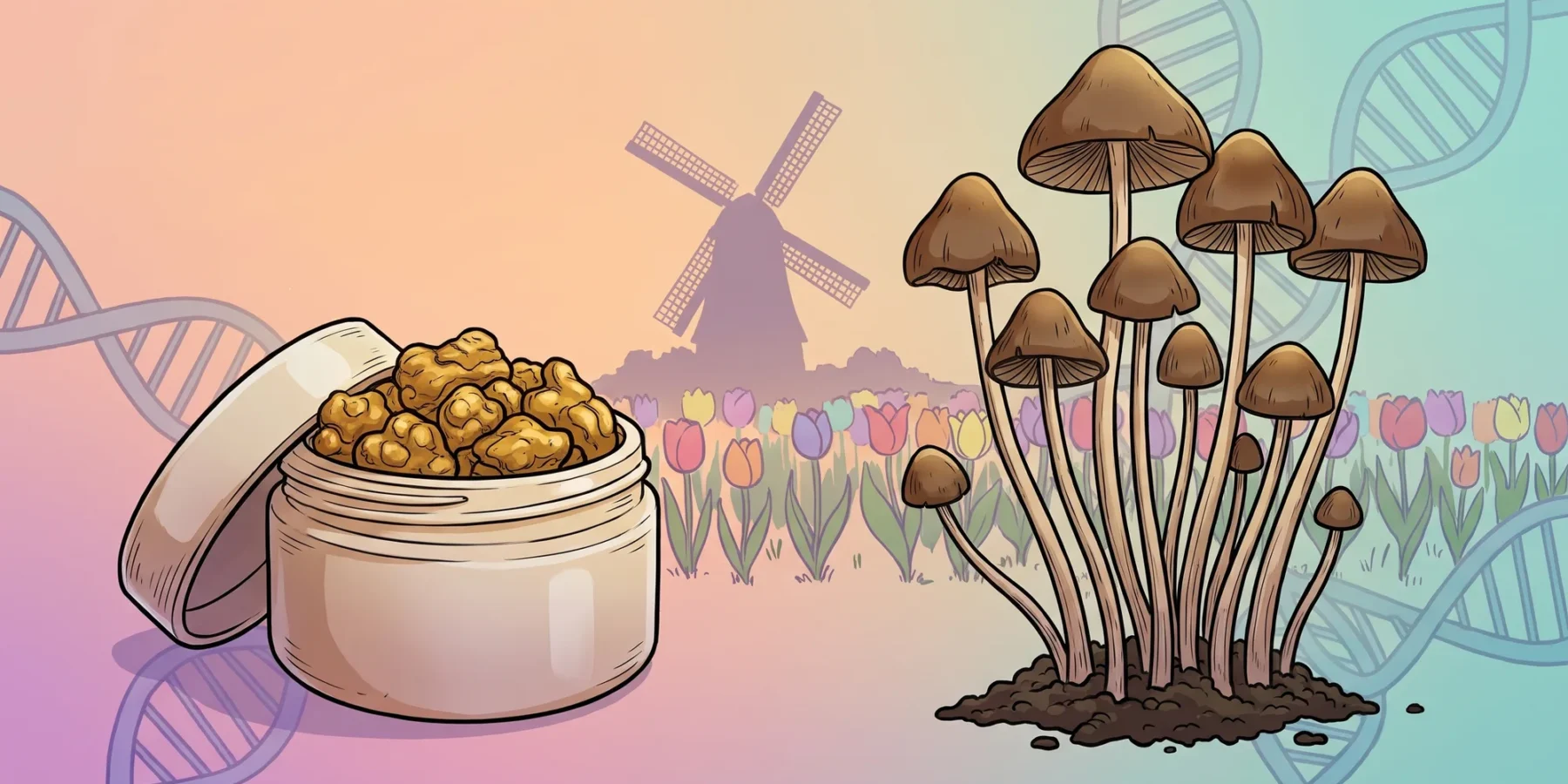
Magic truffles are sclerotia, hard and compact lumps of mycelium that certain psilocybin-producing fungi form underground as a survival structure. The name comes from their look, since biologically they are a different structure from the culinary truffles sold in delicatessens. They became widely known after 2008, when the Netherlands banned psilocybin mushrooms but left sclerotia out of the ban, which is why Dutch smart shops still sell them today.
Only a handful of Psilocybe species form them, and the best known of these was discovered by the same Texas physician who appears in the history of the Penis Envy strain. The Dutch legal exemption is also narrower than many visitors assume.
What are magic truffles? Sclerotia explained
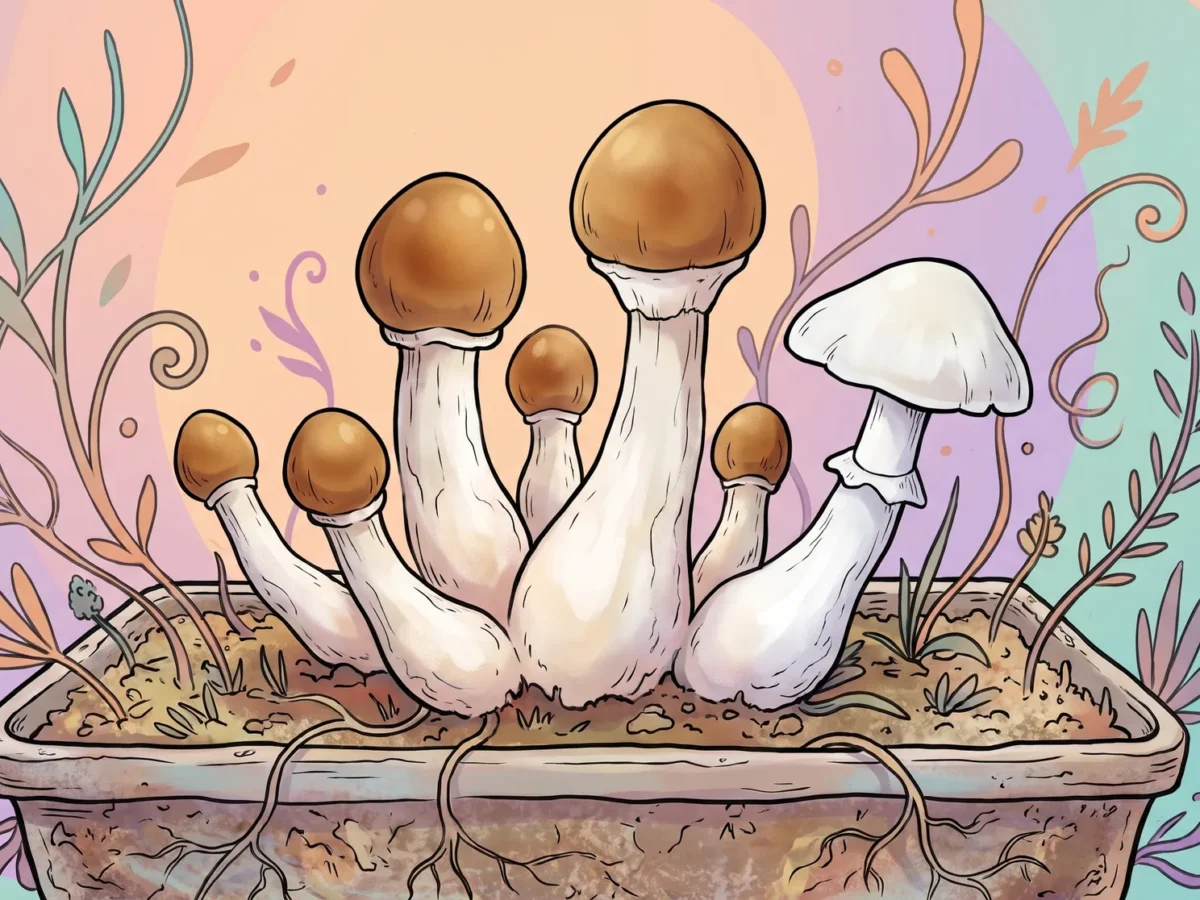
A sclerotium is a dense mass of hyphae, the microscopic threads that make up a fungus, packed tightly together and wrapped in a darker, tougher outer layer. Inside, it stores nutrients and holds relatively little water. That structure lets the fungus survive conditions that would kill ordinary mycelium, such as drought, cold or fire, and grow again once conditions improve.
Sclerotia were long mistaken for separate organisms. In 1853 the French mycologist Louis René Tulasne showed that they are a stage in the life cycle of fungi that were already known, not species of their own. They are common across the fungal kingdom. Ergot on rye, for example, is the sclerotium of Claviceps purpurea, and many plant pathogens overwinter in this form.
For psilocybin species from open grassland and sandy soils, this has a clear ecological logic. A dense lump below the surface can survive a dry summer or a grass fire that destroys everything above ground, then produce new mycelium and mushrooms when rain returns. Commercially grown magic truffles are usually light to dark brown, irregular in shape and somewhere between a pea and a walnut in size, with a firm, slightly rubbery texture when fresh.
Are magic truffles a fruiting body?
A mushroom is a fruiting body, a temporary structure that produces and releases spores. A sclerotium produces no spores at all. It is a resting and storage form of the mycelium. Truffle-forming Psilocybe species still need to grow mushrooms above the surface in order to reproduce, and the sclerotia help the organism wait out bad seasons.
This also separates magic truffles from culinary truffles. Black and white truffles of the genus Tuber are fruiting bodies that happen to develop underground, and they rely on animals digging them up to spread their spores. The two share a name only because both are knobbly lumps found below the surface.
Which Psilocybe species form sclerotia?
Only a minority of psilocybin-producing species are known to form sclerotia, and none of them is the species most people have in mind when they think of magic mushrooms.
- Psilocybe tampanensis: the best known truffle species, sold under the nickname Philosopher’s Stones. It forms sclerotia readily in culture.
- Psilocybe mexicana: a Mexican species with a long history of ceremonial use. In 1958 Albert Hofmann first isolated psilocybin from cultivated material of this species.
- Psilocybe atlantis: a close relative of P. tampanensis, grown commercially in the Netherlands for its sclerotia.
- Psilocybe caerulescens: another member of the same group of Mexican and American species that can produce sclerotia.
Psilocybe cubensis, the species behind almost all grow kits and strains such as Golden Teacher, is not known for forming sclerotia. That is one reason the cubensis world and the truffle world remained largely separate, with different species, different growing methods and, in the Netherlands, a different legal status.
The story of P. tampanensis connects back to cubensis history. In September 1977, during the Second International Mycological Congress in Tampa, Florida, the physician and mycologist Steven Pollock collected a single specimen of an unknown bluing mushroom in a sandy area near the city. He cloned it into a pure culture, and in 1978 he and the Mexican mycologist Gastón Guzmán described it as a new species in the journal Mycotaxon. Pollock was granted a US patent in 1981 for a method of producing sclerotia. The same Pollock is the Texas physician linked to the early history of the Penis Envy cubensis strain. The species was not found again in the wild in Florida for more than four decades, and almost all material in circulation descends from his original clone.
Magic truffles vs magic mushrooms: a side by side comparison
The two forms come from the same kind of organism but differ in almost every practical respect. The table summarises the main points.
| Feature | Magic truffles (sclerotia) | Magic mushrooms (fruiting bodies) |
|---|---|---|
| What it is | Hardened mass of mycelium | Reproductive structure of the fungus |
| Where it forms | Inside the substrate or underground | Above the surface |
| Produces spores | No | Yes |
| Typical species | P. tampanensis, P. mexicana, P. atlantis | P. cubensis, P. semilanceata and many others |
| Look and texture | Brown knobbly lumps, firm and dense | Cap, gills and stem |
| Time to form in culture | Roughly 3 to 12 weeks on rye grass seed or similar substrates | Depends on species and method |
| Legal status in the Netherlands | Legal to sell under the Opium Act | Banned since 1 December 2008 |
Chemically, both contain psilocybin and psilocin, the compounds that make these fungi psychoactive. The concentration differs between species, growing conditions and the water content of the material. Sclerotia are usually sold fresh and vacuum packed, while mushrooms are often dried, which makes direct comparisons by weight misleading.
Why are magic truffles legal in the Netherlands?
Until 2008, fresh psilocybin mushrooms were sold openly in Dutch smart shops. Dried mushrooms were already illegal, but in 2002 the Dutch Supreme Court ruled that fresh mushrooms did not fall under the Opium Act. That changed after a series of incidents involving tourists, including the death of a young French woman that caused tension between France and the Netherlands. In October 2007 the government announced a ban, and a court in The Hague allowed it to take effect as planned on 1 December 2008. From that date, more than 180 psilocybin-producing fungi were added to List II of the Opium Act. Growing, selling or possessing them became illegal.
Sclerotia were left off that list following an independent advisory report. The Dutch health ministry has said that truffles did not show the same level of harm as the mushrooms and were therefore not included in the 2008 amendment, a position it still holds. The formerly niche product, which one Dutch grower told Vice had made up less than 20% of his business before the ban, became the only legal psilocybin product in the country almost overnight. The ministry has confirmed to Dutch media that commercial cultivation and sale of sclerotia, even on a large scale, is legal.
Are magic truffles legal elsewhere in Europe?
Most other European countries treat them like mushrooms. The Dutch exemption works because the Opium Act lists specific fungi by name. Most other countries control psilocybin and psilocin as substances, in line with Schedule I of the 1971 UN Convention on Psychotropic Substances. Under that approach, anything containing them, mushroom or sclerotium, falls under the same rules.
That has a practical consequence for travellers. Buying truffles legally in Amsterdam does not make it legal to carry them across a border, send them by post or possess them at home. If you are researching this topic for anything beyond curiosity, check the current law in your own country, since penalties and enforcement vary widely across the EU.
e-shroom does not sell sclerotia. Our Psilocybe cubensis kits are sold for microscopy, observation and education. To see how cubensis behaves as living mycelium, read our article on the Full-Auto grow kit format, meet one of the classic strains in our Golden Teacher profile, or explore the history of the field through our selection of books on psychedelics and mushrooms.