Deutsch
 Français
 Nederlands
 Español
 Čeština
 Українська
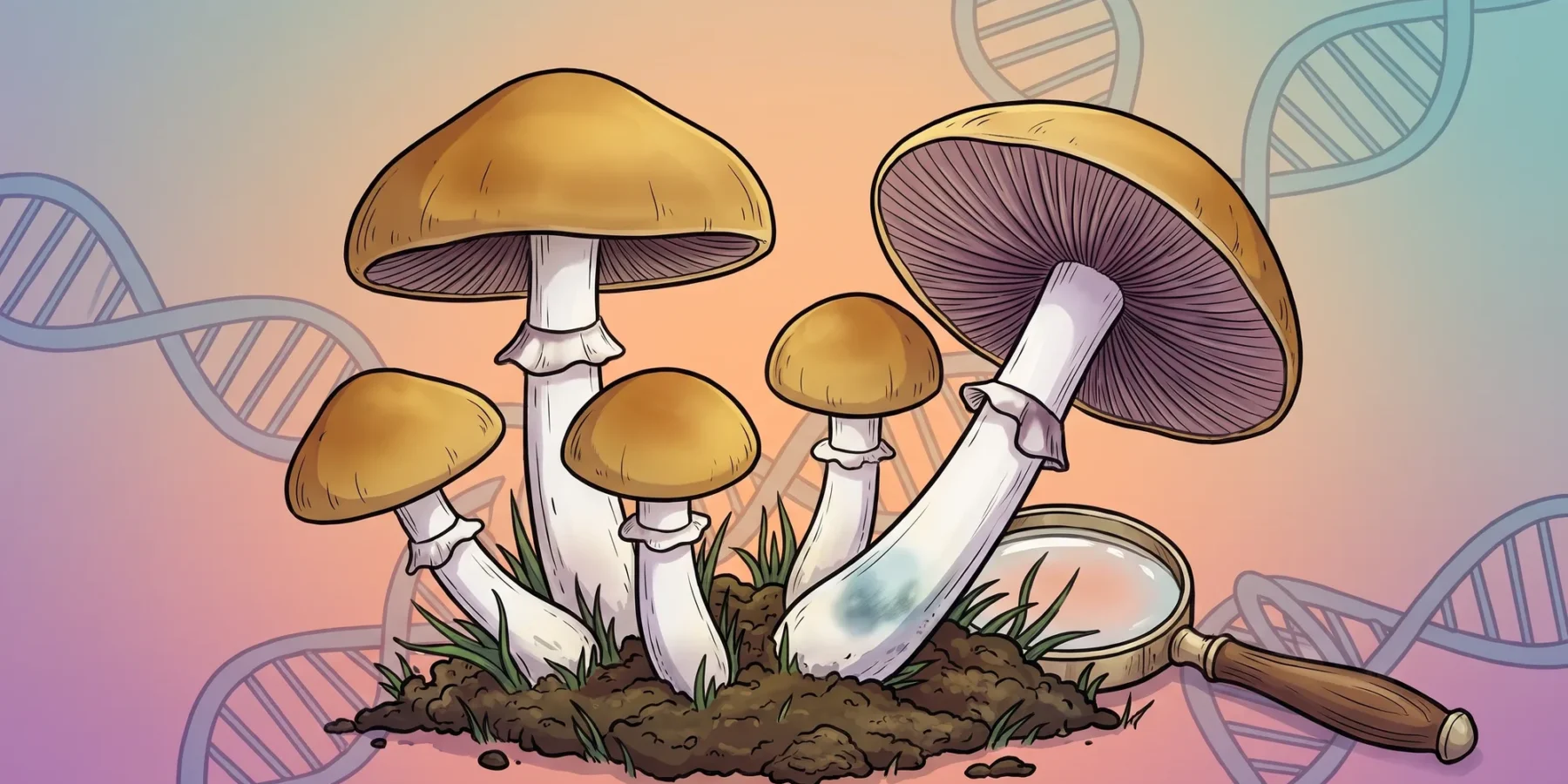
Psilocybe cubensis is the most widely known psilocybin-producing mushroom in the world and the species behind almost every named strain, including Golden Teacher and Penis Envy. It is a tropical and subtropical fungus that grows on the dung of grazing animals, recognisable by its golden-brown cap, dark purple-black gills, white stem with a persistent ring, and blue bruising wherever it is damaged.
The species has carried at least four scientific names since 1906 and grows wild on several continents, though not in most of Europe. It also has lookalikes that contain the same toxins as the death cap, which makes reliable identification a safety issue as well as a collector’s concern.
What is Psilocybe cubensis? Taxonomy and history of the name
The species was first described in 1906 by the American mycologist Franklin Sumner Earle as Stropharia cubensis, based on material collected in Cuba. The epithet cubensis means coming from Cuba. A year later, the French mycologist Narcisse Patouillard described the same fungus from Tonkin, in what is now Vietnam, under a different name, and in 1941 William Murrill described it again from near Gainesville, Florida. In the late 1940s the German-born mycologist Rolf Singer moved it into the genus Psilocybe. Psilocybe cubensis has been its accepted name ever since.
The genus name comes from the Greek words psilos and kube, meaning bare head, a reference to the smooth caps of many species. Psilocybe cubensis belongs to the family Hymenogastraceae, and its older names, including Stropharia cubensis, still appear in literature from the 1970s.
Western interest in psilocybin mushrooms grew rapidly after 1957, when the banker and amateur mycologist R. Gordon Wasson published an account of Mazatec mushroom ceremonies in Mexico in Life magazine. In 1958 Albert Hofmann isolated psilocybin, and in 1976 Terence and Dennis McKenna, writing under pseudonyms, published a short guide that adapted earlier button mushroom cultivation methods to P. cubensis. Its reputation as one of the easiest psilocybin species to cultivate dates from that period.
How to identify Psilocybe cubensis: cap, gills, stem and spores
Mycologists identify P. cubensis by a combination of features, because no single trait is enough. The measurements below come from standard descriptions of the species.
| Feature | Description |
|---|---|
| Cap | 1.6 to 8 cm across, conical or convex when young, flattening with age. Smooth, slightly sticky, brown at the centre and paler toward the edge, often golden-brown or yellowish when mature |
| Gills | Attached to the stem, grey at first, darkening to purplish-black with a mottled look. Edges stay whitish |
| Stem | 4 to 15 cm tall and 0.4 to 1.4 cm thick, white, hollow, yellowing with age |
| Ring | Persistent and membranous, usually darkened by falling spores |
| Spores | 11.5 to 17.3 by 8 to 11.5 micrometres, sub-ellipsoid, dark purple-brown in mass |
| Bruising | All parts turn blue where handled or damaged |
The blue bruising comes from the oxidation of psilocin and related compounds after cell damage, which is why it is common across psilocybin-producing species. It is a useful field character, though other genera bruise blue as well, and its strength varies with freshness and conditions.
Where does Psilocybe cubensis grow in the wild?
P. cubensis is pantropical. It grows on cattle dung, occasionally on horse dung, on sugar cane mulch and on rich pasture soil, and in Asia on the dung of water buffalo. Reported range includes the US Gulf Coast and southeast, Mexico, Central and South America, the Caribbean, Southeast Asia, India and Australia, where it reaches from northern Queensland to southern New South Wales. In 2018 it was reported from Zimbabwe, the first record of a psilocybin mushroom in that country.
It does not grow wild in most of Europe because the climate is too cool. European psilocybin species, such as the liberty cap Psilocybe semilanceata, are different organisms with different habitats.
Psilocybe cubensis lookalikes: species that can be dangerous
Pastures and dung heaps host many small brown mushrooms, and several of them grow side by side with P. cubensis. Some are harmless, some cause unpleasant poisoning, and a few can kill. Species reported as confusion risks include:
- Galerina species: small brown mushrooms that contain amatoxins, the same liver-destroying toxins found in death caps. Potentially deadly.
- Pholiotina rugosa: a slender pasture species that also contains amatoxins. Potentially deadly.
- Chlorophyllum molybdites: a large lawn and pasture mushroom with a green spore print, and a common cause of severe gastrointestinal poisoning.
- Panaeolus semiovatus: a dung-loving species with a similar look that does not stain blue.
- Psilocybe subcubensis: a tropical relative that looks identical and can only be separated by its smaller spores.
The last entry shows why identification by eye is unreliable even for experts. Confirming a species usually needs a spore print, microscopy and sometimes DNA. Foraging for wild psilocybin mushrooms carries a real risk of fatal poisoning, and the descriptions here are no substitute for a field guide or an expert.
Psilocybe cubensis strains: how do they differ?
Within one species, growers recognise hundreds of named strains. A strain is a line of cultures selected for traits such as size, colour, cap shape, growth speed or contamination resistance. Strains are not botanical varieties, and their names are not registered anywhere, so two vendors can sell different genetics under the same label.
| Strain | How it is usually described | What is documented |
|---|---|---|
| Golden Teacher | Golden caps that open wide, reliable growth | Long established, see our profile below |
| Penis Envy | Thick stems, caps that barely open, few spores | Linked to Steven Pollock in Texas, origin disputed |
| Mazatapec | Medium-sized, classic cubensis shape | The name refers to the Mazatec people of Oaxaca, Mexico |
| McKennaii | Large fruits, dense clusters | Named in honour of Terence McKenna |
| Jack Frost | Pale, almost white fruiting bodies | A recent cross of albino lines |
The most reliable differences between strains are visual: colour, cap shape, stem thickness and how heavily they sporulate. Claims about chemistry are another matter. Analyses of P. cubensis show psilocybin, psilocin, baeocystin, norbaeocystin and aeruginascin, with concentrations that vary considerably between samples and even between harvests of the same culture. A peer-reviewed comparison showing that one named strain is consistently stronger than another does not exist.
For a closer look at individual strains, start with our Golden Teacher article, or browse the lines we prepare in our cubensis grow kits, including Mazatapec, McKennaii and Jack Frost x Shakti.
Is Psilocybe cubensis legal in Europe?
Psilocybin and psilocin are listed in Schedule I of the 1971 UN Convention on Psychotropic Substances, and every EU member state controls them under national law. The mushrooms themselves are not named in the convention, so each country decides how to treat fresh and dried mushrooms, spores and mycelium. In practice, fresh and dried P. cubensis mushrooms are illegal to possess or sell across the EU, while the status of spores and kits differs from one country to the next. The Netherlands, for example, banned psilocybin mushrooms in 2008 but not the sclerotia of other species.
Our kits are sold for microscopy, observation and education, and buyers are responsible for knowing the rules in their own country. They arrive as live P. cubensis mycelium on substrate, sealed in a bag with a filter, so the culture can be watched without opening it. Before observation the kit is kept in a fridge at 2 to 4°C, and during observation a stable 20 to 26°C away from direct sun and radiators is recommended. Our article on the Full-Auto grow kit format explains how this closed system differs from a classic kit you open and mist yourself, and why watching the same spot over several days is the most reliable way to tell healthy white mycelium from early mould. If you are unsure, check with official national sources before ordering spores, cultures or kits of any cubensis strain.