Deutsch
 Français
 Nederlands
 Español
 Čeština
 Українська
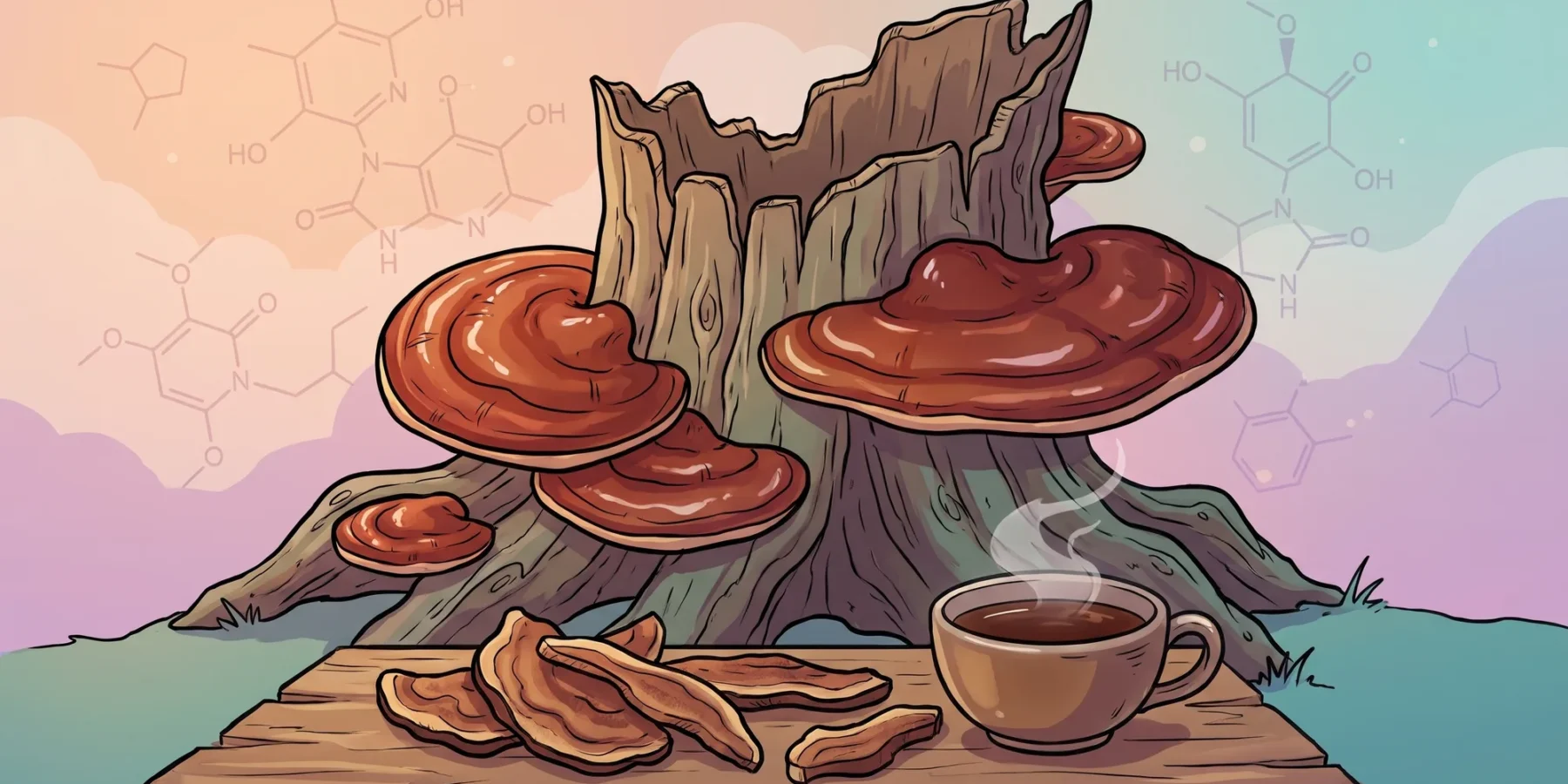
Reishi mushroom benefits are claimed for immunity, sleep, blood sugar, stress, cancer and much more. The mushroom, known as lingzhi in China and reishi in Japan, has been part of East Asian traditional medicine for centuries, and that long history is often presented as proof. Clinical trials found a few modest effects in specific groups of patients and nothing at all in several areas that marketing covers. They also turned up safety signals.
Two details rarely make it onto the pack. The name reishi covers two species with different chemistry, and powdered reishi has been linked to rare cases of liver injury.
What is reishi? Ganoderma lucidum, lingzhi and the naming problem
Reishi is a wood decaying polypore with a glossy, lacquered, usually red-brown cap and a hard, woody texture. It is far too tough to eat as a vegetable. Traditionally it was sliced and boiled for hours into a bitter decoction, and today it is sold mostly as extracts, capsules, spore powder or tea.
Almost every product and study uses the name Ganoderma lucidum, yet that name is probably wrong for most of them. G. lucidum was originally described from England. In 2012, researchers showed that the lingzhi cultivated widely in China, Japan and Korea is a genetically distinct species, which they named Ganoderma lingzhi. Some taxonomists use G. sichuanense instead, and the debate over the correct name continues.
Does the reishi species name change what you buy?
A 2016 study that compared a European G. lucidum strain with an East Asian G. lingzhi strain, both grown commercially, found that the European fungus contained much lower levels of triterpenic acids, one of the main groups of compounds studied in reishi. So two products both labelled reishi can differ in chemistry, and research on one species does not automatically transfer to the other.
The form of the product adds another layer. Hot water extracts concentrate polysaccharides such as beta-glucans. Alcohol extracts concentrate triterpenes. Spore powder is a different material again. When reading about a study, check which form and species were tested before assuming your capsule will act the same way.
Reishi mushroom benefits backed by clinical trials
Human trials on reishi exist, but most are small, short and conducted in East Asia, often with commercial extracts. The table summarises the strongest evidence available by topic.
| Use | What trials found | Strength of evidence |
|---|---|---|
| Lower urinary tract symptoms in men | Modest improvement in symptom scores, no change in flow or prostate size | Moderate, two Japanese trials |
| Fatigue in neurasthenia | Better fatigue and well-being scores than placebo after 8 weeks | Low to moderate, one trial |
| Support during cancer treatment | Higher response to chemotherapy or radiotherapy, better quality of life | Low, five small trials |
| Blood sugar, blood pressure, cholesterol | No meaningful effect | Low, but consistently negative |
Reishi for urinary symptoms and fatigue
The most consistent results come from men over 50 with mild to moderate lower urinary tract symptoms, often linked to an enlarged prostate. In a 2008 Japanese trial, 88 men took an ethanol extract of reishi or placebo for 12 weeks. The reishi group improved more on the International Prostate Symptom Score, by a mean difference of 1.18 points, while urine flow, residual urine, prostate volume and PSA levels did not change. Laboratory work suggests the extract inhibits 5-alpha reductase, the same enzyme targeted by some prostate drugs.
For fatigue, a Chinese trial published in 2005 gave 132 patients diagnosed with neurasthenia, a condition defined by chronic fatigue and poor concentration, a reishi polysaccharide extract or placebo for eight weeks. Fatigue scores fell by 28.3% with reishi against 20.1% with placebo, and 51.6% of the reishi group were rated clearly improved compared with 24.6% on placebo. It is one trial, using one branded extract, so it needs replication before anyone can call reishi a fatigue treatment.
Reishi and cancer, blood sugar and immunity: weaker evidence
Reishi marketing is most aggressive around cancer, which is also where a wrong decision costs the most. A 2016 Cochrane review pooled five randomised trials and found that patients who took reishi extract alongside chemotherapy or radiotherapy were 1.27 times more likely to respond to treatment and reported better quality of life. Reishi on its own did not shrink tumours. The reviewers judged the trials to be of low quality and concluded that reishi could be considered only as an addition to conventional treatment, not a replacement, given the limited evidence.
Some of the included studies also reported higher counts of immune cells, such as CD3, CD4 and CD8 T cells. Most immunity claims rest on these results. A change in immune markers in lab results is not the same as fewer infections or better survival, and no trial has shown that reishi prevents illness in healthy people.
For cardiovascular risk factors the verdict is clearer and negative. Another Cochrane review, from 2015, analysed five trials with 398 participants, mostly people with type 2 diabetes, who took 1.4 to 5.4 g of reishi a day for 12 to 16 weeks. Reishi did not produce statistically or clinically meaningful changes in HbA1c, cholesterol, blood pressure or triglycerides compared with placebo.
Several other popular claims lack human evidence altogether:
- Sleep: improvements appear mainly in animal studies, with no solid trial in people with insomnia.
- Anxiety and depression: a few small studies report better mood scores, mostly in cancer patients, without strong controls.
- Liver protection: suggested by animal work, while the human case reports point in the opposite direction, as covered below.
- Longevity: based on tradition and lab models only.
If any of these is your main reason for considering reishi, a doctor’s assessment of the underlying problem will almost always be more useful than a supplement.
Reishi side effects, liver cases and drug interactions
In short clinical trials, reishi is usually well tolerated. Reported side effects include nausea, insomnia, dry mouth, itching, dizziness and digestive upset. The more serious concerns come from case reports and from how reishi interacts with medication.
Liver injury is the most important signal. A fatal case of fulminant hepatitis was published in Thailand in 2007, following an earlier case in Hong Kong in 2004. In both, the patients had used traditionally boiled reishi without problems and developed liver damage one to two months after switching to reishi powder. Later reports describe liver injury ranging from mild enzyme rises to acute hepatitis. Nobody has identified the compound responsible, and these cases remain rare, but they explain why powders deserve more caution than tea.
Reishi may also interact with medicines:
- Blood thinners and antiplatelet drugs, including warfarin, because reishi extracts may prolong clotting times and raise bleeding risk.
- Immunosuppressants, since reishi may stimulate immune responses these drugs are meant to suppress.
- Chemotherapy, where an interaction is theoretical but should be discussed with the oncology team.
- Planned surgery, for the same bleeding reason, so stop taking reishi in advance and tell your surgeon.
People who are pregnant or breastfeeding have no safety data to rely on and should avoid reishi supplements. Spore powder can also raise the tumour marker CA72-4 in blood tests, which may confuse cancer monitoring.
How to choose reishi and what to expect
If you decide to try reishi after checking with your doctor, judge it by the label. A useful product states the species, whether the extract comes from the fruiting body, the mycelium or the spores, the extraction method and the content of beta-glucans or triterpenes per serving. Trials have used daily amounts from around 1.4 g to over 5 g of material, so a product with a few hundred milligrams of unspecified powder is unlikely to resemble any studied preparation. In the EU, no health claim for reishi has been authorised, so a pack promising specific health effects is a warning sign.
Reishi also makes a slow, visible project for anyone who grows it. Its fruiting bodies develop slowly from pale knobs into glossy antlers or shelves, and the shape depends heavily on fresh air: low airflow tends to produce antlers, while more air encourages the classic kidney-shaped cap. Our functional kits bring reishi into the sealed Full-Auto format, where the producer gives one to six months for the characteristic shapes to form. For more background on fungi and how they grow, browse the e-shroom blog.
This article is for general information and does not replace medical advice. Talk to your doctor before taking reishi, especially if you take medication or have a health condition.